The short answer
Empty the used leaves, follow each item’s care instructions, rinse away detergent and let the parts dry before storing. Check lids, seams and removable seals as well as the cup itself; stain treatments must suit the particular item.
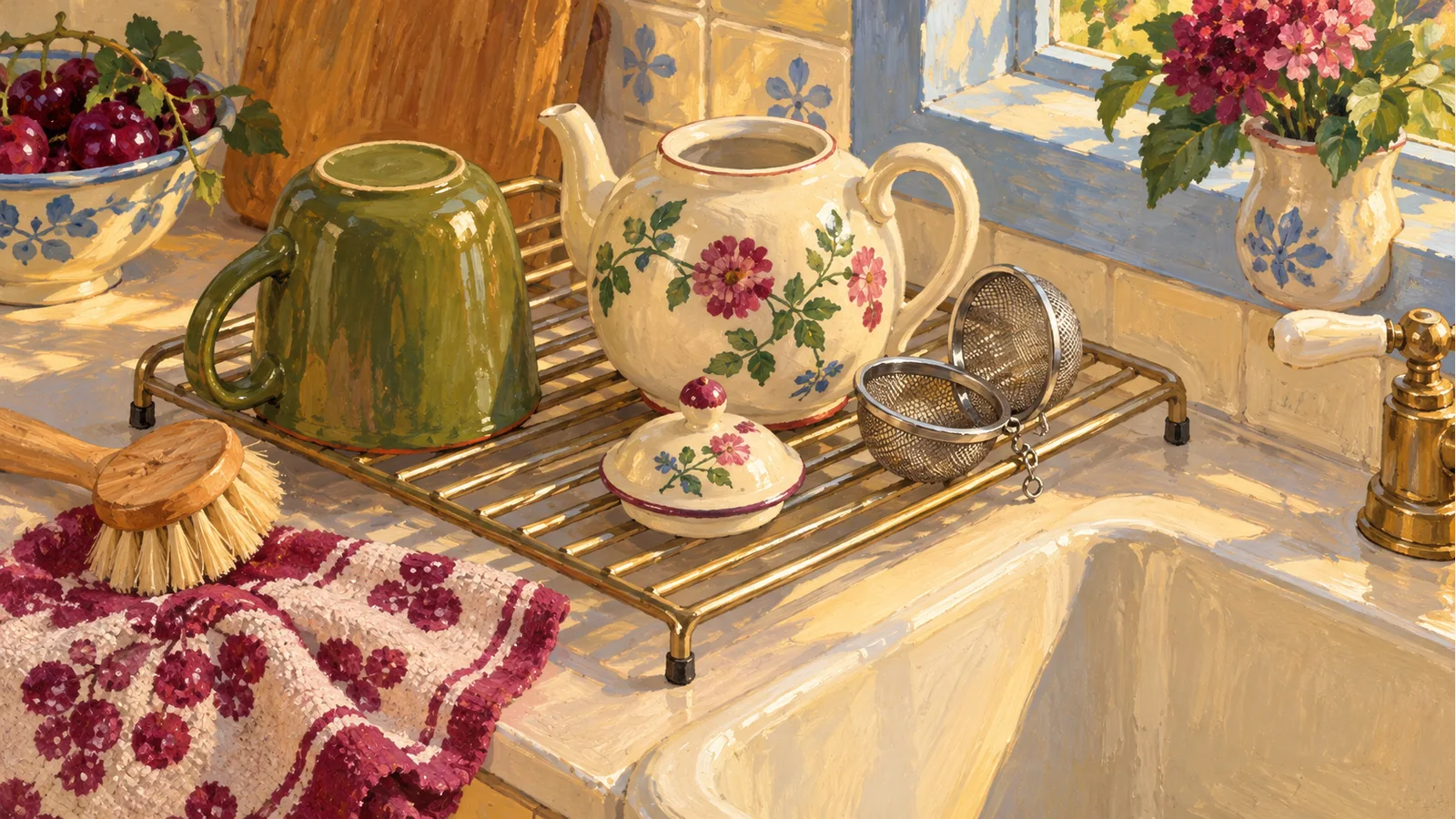
The cup is finished, but the basket is still wet and the teapot lid has disappeared under a cloth. A small after-tea routine makes tomorrow’s brew easier. It also gives you a moment to notice a loose lid, a damaged filter or a part that needs more attention.
Start with the items you own and their care instructions. A glazed mug, a fine mesh basket and an insulated flask may sit together on the counter, but they need not share a cleaning method. This guide is for ordinary everyday equipment; use specialist advice for unglazed clay, antiques and delicate decoration.
Know the parts before washing
Look beyond the main material. An infuser may have metal mesh, a plastic frame and a separate lid. A flask may hide removable seals inside its cap. Check which parts detach, which can go in the dishwasher and which should only be washed by hand.
For example, Finum lists its Brewing Basket M as dishwasher-safe, including its stainless mesh and heat-tolerant frame. That is a useful specification for that particular basket, not permission to put every infuser in the same wash.
Give the everyday wash a clear finish
Once the equipment is safe to handle, remove used leaves or bags and empty the remaining tea. Wash as directed, reach the accessible seams and corners, and rinse away detergent. Give detachable pieces a place to drain where they will not vanish down the sink or become mixed up with another lid.
Let everything dry before returning it to storage. It helps to choose one small area for this job rather than spreading parts across the kitchen. A dish for the wet infuser during brewing and a separate drying spot afterwards make the tea-station reset easier to follow.
Give lids and seals their own attention
A clean-looking cup does not tell you whether the lid is clean. Thermos points out that residue can collect beneath gaskets and between parts, and directs owners to each product’s care manual. Follow the disassembly diagram rather than prying out a part that was never meant to detach.
Set the pieces out in the order you remove them, if that helps you remember the assembly. Before the next use, check them against the diagram. If a seal is missing or a part no longer fits properly, find the manufacturer’s replacement or support advice before relying on the lid.
Treat stains according to the item
A brown tea mark can be an invitation to reach for the strongest cleaner in the cupboard. Pause and check the care page first. There is no single stain-removal recipe for all glazes, coatings, plastics and metals.
FORLIFE’s Stump teapot instructions, for example, recommend baking soda dissolved in warm water for tea stains. They also identify the pot, lid and basket materials separately. This is a bounded example of manufacturer advice, not a recommendation to soak every tea tool in the same solution.
Keep stain treatment separate from the normal wash: use only a method permitted for the item, follow the cleaner’s directions, and complete the rinse afterwards. If the instructions are missing, identify the maker and model before experimenting. You do not need to restore a showroom appearance at the expense of a coating or a seal.
Put the kit back together for the next cup
Once the pieces are dry, return the basket to its familiar place and keep lids with the right vessels. Store the care instructions digitally or with your household manuals so a deeper clean does not become a fresh research project.
If washing a particular tool is consistently awkward, note what gets in the way: a seam you cannot reach, a lid with too many small pieces, or a basket that is difficult to empty. That gives you a concrete requirement if you eventually replace it. For choosing a format, Have More Tea compares baskets, balls and paper filters. Here, the aim is simply to leave the equipment you already use ready for another cup.
Sources and approach
Primary examples: Finum Brewing Basket M specifications, Thermos cleaning guidance and FORLIFE Stump teapot care instructions, linked above. These are not hands-on cleaning tests or product endorsements. The reset sequence is NareeTea editorial advice. Sources checked 10 October 2026.
Everyday questions
Can every infuser go in the dishwasher?
No. Check the whole item, including its frame, handle and lid. Dishwasher-safe examples do not establish a rule for other products.
Is a rinse enough for a travel flask?
Follow its cleaning directions, including the lid and seals. A quick rinse does not replace the full routine specified by the manufacturer.
Can I use baking soda on every teapot?
No. FORLIFE recommends it dissolved in warm water for stains on its Stump teapot. That is product-specific advice.
Should I take every seal out?
Remove only the parts the manual tells you to remove. Some seals are integrated, and forced removal can damage them.
Can I apply this to an unglazed clay pot?
Use the maker’s specialist instructions. This everyday routine is not a care guide for unglazed clay, antiques or decorated heirlooms.
When should the tools go back in the cupboard?
After they are clean and dry, following their care instructions. Keep detachable pieces together so the next brew is easy to prepare.